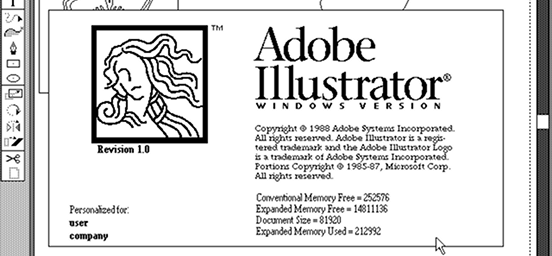
There was a time when the acronym “AI” didn’t send shockwaves through the creative industry. It didn’t mean generative prompts, machine learning, or automated layout generation. It simply meant .ai—the file extension for Adobe Illustrator. Back then, “AI” was something you built by hand, node by node, anchor point by anchor point. The Era of Pen Tool Mastery For those of us who learned the craft on Illustrator v4 or earlier, design was a physical workout in precision. There were no shortcuts, no natural language prompts, and certainly no algorithms predicting your next visual move. We spent hours:
- Conquering the Pen Tool: Learning how to control Bezier curves without turning a smooth arch into a jagged mess.
- Editing Vector Paths: Manually adding, removing, and adjusting anchor points to perfect a single logotype.
- Mastering Pathfinder: Struggling through compound shapes, subtle offsets, and manual kerning before intelligent layout features existed.
Every curve was intentional. Every vector path was earned. When Technical Constraint Built Deep Craft Because the tools didn’t do the thinking for us, we had to develop an undeniable foundation in typography, visual hierarchy, and spatial balance. The struggle to manipulate vectors taught us why a design worked, not just how to output it quickly. When you spend forty minutes manually fine-tuning a custom letterform, you develop an intimate understanding of proportion and visual weight that no automated prompt can teach you.
The Friction That Built the Intuition
The Friction That Built the Intuition
That manual effort wasn’t just labor; it was a feedback loop between hand, eye, and intent. When every edit carried a time cost, decision-making had to be deliberate. You didn’t generate thirty variations to see what landed—you mentally modeled the execution before laying down a single anchor point. That necessity cultivated a rare kind of design discipline: muscle memory for visual tension, optical compensation, and narrative clarity.
The Erasure of the Process
Modern generative workflows excel at volume and immediacy, but they compress the exact stage where deep understanding happens—the space between execution and refinement. When speed becomes the primary metric of production, iteration turns into selection rather than creation. You choose from a menu of outputs instead of building a form from first principles.
While that trade-off delivers unmatched efficiency, it risks producing a generation of designers who recognize good work without knowing how to rebuild it when the system hallucinates or breaks down.
Craft as an Internal Blueprint
The mastery earned through constraint doesn’t lose value as tools evolve—it becomes more critical. Designers who spent hours mastering kerning, manual grid alignment, and vector geometry carry an internal blueprint. They aren’t reliant on default parameters or algorithmic guesswork. They know precisely why a composition feels off balance, where a letterform loses legibility, and how to direct the automated tools rather than merely accepting their default output.
In an era of limitless, instantaneous output, craft is no longer defined by how fast you can make something. It is defined by the depth of judgment you bring to what you create.
“The computer is really like a pencil. The pencil can do anything you want, but you have to do it. You have to play yourself to get the most out of it.”
The Tool Analogy — Massimo Vignelli