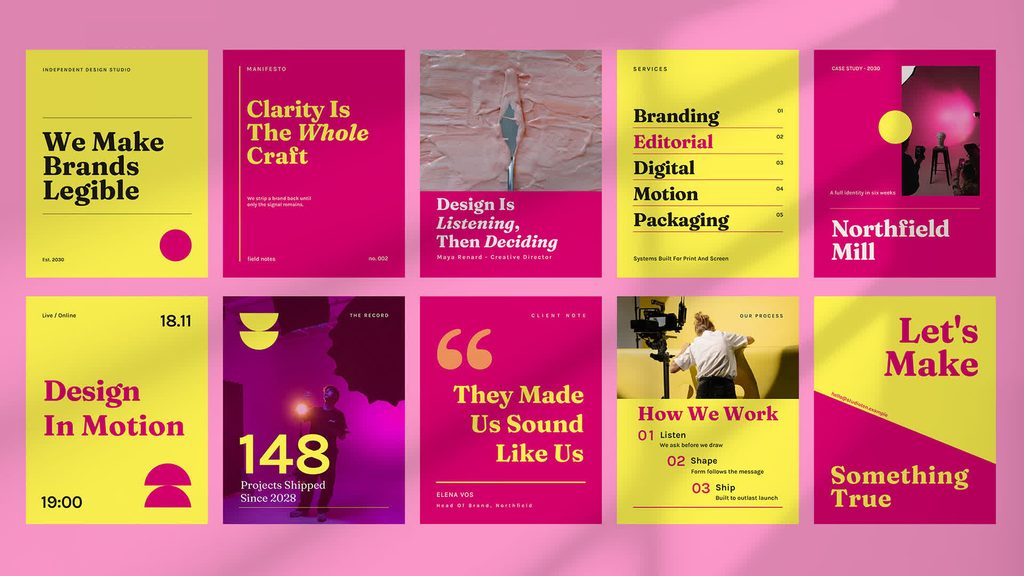

I’ve been feeling a deep sense of nostalgia lately. Not just for classic design, but for the messy, imperfect, and wonderfully weird things people used to create by hand. Remember early web design, indie zines, and local gig posters? Sure, a lot of it was technically “ugly,” but it had soul. It was idiosyncratic, wildly personalized, and unmistakably human. Someone spent time making decisions, making mistakes, and leaving their personal fingerprint on the page. Fast forward to today, and we’re facing a very different kind of ugly—a glossy, repetitive, machine-made homogeneity:

- The mandatory fluorescent yellow links on dark-mode landing pages.
- The exact same generic icon sets repeated across every single startup site.
- The signature “three glowing dots” floating beside every input box.
- Overstuffed layouts crammed with information simply because a tool could generate it in seconds.
As an AI Designer, I embrace these new tools every day.
But when everyone relies on the same prompts, default templates, and machine outputs without applying a critical human eye, brand identity fades away. We trade personality for speed, replacing raw human creativity with hyper-polished visual noise. I miss the quirks. I miss the intentionality. I miss the handcraft. Generative technology should free us to explore bolder, more unique ideas—not flatten our visual landscape into a single template. Beautiful design doesn’t come from pushing a button; it comes from human judgment, restraint, and the courage to make something that actually feels real. Do you miss the raw, personalized feel of early hand-crafted design, or do you think we can bring that soul back into modern workflows? Let’s connect and chat.

The Death of the Happy Accident
Algorithmic polish has eliminated the productive mistake. When you work with physical materials—or even primitive vector software—imperfections force pivot points. A misaligned grid becomes a dynamic visual anchor; an unexpected color bleed turns into a core brand element. Generative AI doesn’t make mistakes; it outputs averages. By flattening variance into statistical probability, it strips away the exact edge cases where real style is born.
Standardization is the New Invisibility
When every brand leverages the same diffusion models and prompt frameworks, the entire visual culture converges toward a single, synthetic mean. We are currently drowning in a sea of flawless, soulless visual noise—hyper-detailed, perfectly rendered, and completely forgettable. True distinction today isn’t about achieving higher fidelity; it’s about exercising human restraint. It’s about knowing what to leave out, where to break symmetry, and when to let the raw texture of human intent show through.
The Counter-Culture of Real Craft
The Anti-Ugly AI Poster Club isn’t about resisting progress or retreating into nostalgia. It’s a call to elevate the bar. AI is an execution engine, not an aesthetic compass. When we surrender our visual judgment to automated tools, we don’t just lose craft—we erase the artist behind the work.
The future of design won’t belong to those who can prompt the fastest, but to the stubborn few who refuse to let machine default dictate human culture. We aren’t here to optimize output; we’re here to build work that actually means something.